The organizers of the Dakar Rally have once again raised the stakes for the 2025 edition, unveiling a route that promises to push competitors to their absolute limits. Among the most talked-about additions is the inclusion of the infamous "Devil's Dune" in the Sahara Desert, a monstrous sand formation that has long been whispered about in off-road racing circles but never before featured in the rally. This year's course is shaping up to be one of the most technically demanding in the event's storied history.
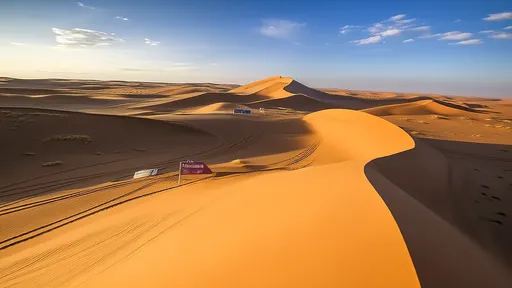
The Devil's Dune isn't just another sandy obstacle - it's a veritable mountain of shifting grains that has claimed countless vehicles during private testing sessions. Standing at over 150 meters tall with a 45-degree incline on its steepest face, this natural phenomenon has been deliberately avoided by rally planners until now. "We've known about this dune for decades," admits race director David Castera. "But we needed to wait for vehicle technology and safety measures to catch up before we could responsibly include it in the route."
Located deep in the Mauritanian sector of the Sahara, the Devil's Dune will appear during the crucial second week of the rally when fatigue begins setting in. Navigation will be particularly treacherous here, as the dune's unique shape creates optical illusions that have fooled even experienced desert guides. The sand composition is another factor - finer and drier than typical Saharan dunes, it offers virtually no traction and swallows tires whole.
Competitors are already voicing mixed reactions to the announcement. Defending champion Nasser Al-Attiyah welcomed the challenge: "This is why we do Dakar - to face what others cannot." However, several privateer teams have expressed concerns about the safety implications, particularly for smaller teams without unlimited budgets for specialized equipment. The organizers have responded by implementing mandatory dune-specific safety briefings and requiring all vehicles to carry additional recovery gear during these stages.
The 2025 route spans approximately 8,500 kilometers across Morocco, Western Sahara, and Mauritania, with about 70% taking place on sand. In addition to the Devil's Dune, planners have incorporated several other new elements designed to test different skill sets. These include a rarely traveled passage through the Draa Valley's fossil beds and a night stage crossing the ancient seabed of the Tiris Zemmour region. The variety ensures that victory will require mastery of every desert driving discipline.
Navigation challenges have been deliberately amplified this year, with fewer visible waypoints in the dune sectors. "The Devil's Dune area has no landmarks for 50 kilometers in any direction," explains veteran co-driver Dirk von Zitzewitz. "You can't rely on visual references - just your compass, your odometer, and instinct." This back-to-basics approach marks a deliberate shift from recent years' increasing reliance on GPS technology.
Environmental considerations have played a major role in planning the Sahara stages. The route carefully avoids sensitive ecological areas and ancient archaeological sites. A team of Mauritanian environmental consultants worked closely with the ASO to minimize impact on the fragile desert ecosystem. Special measures include biodegradable marking flags and restrictions on nighttime bivouacs near the Devil's Dune to protect nocturnal desert species.
The mechanical demands of conquering the Devil's Dune cannot be overstated. Engine cooling systems will be pushed beyond design limits as vehicles struggle up the slope at walking speeds. Transmission temperatures will soar during the inevitable descents where drivers must balance momentum control with preventing catastrophic overheating. Several manufacturers have already announced special Dakar editions of their vehicles with reinforced drivetrains and auxiliary cooling specifically for this challenge.
Local Mauritanian communities have embraced the rally's visit to this remote region. The Devil's Dune stage will pass near the ancient trading post of Ouadane, where residents plan to welcome competitors with traditional hospitality. "The Dakar brings the world to our desert," says tribal elder Mohamedou Ould Beyrouk. "We will show them the true face of Saharan culture." Organizers have arranged cultural exchanges and economic initiatives to ensure the event benefits these isolated settlements.
Safety innovations for 2025 include drone-based medical response teams stationed near high-risk obstacles and real-time vehicle monitoring systems that can detect when a car is stuck or rolled. The Devil's Dune will have three dedicated rescue points stocked with specialized sand recovery equipment. "We're taking every precaution," emphasizes safety director Jean-Pierre Garcin. "But ultimately, the desert decides what happens out there."
The psychological aspect of facing the Devil's Dune may prove more formidable than the physical challenge. Veteran competitors speak of the Sahara's ability to play tricks on the mind after days of relentless racing. The dune's isolation and scale have broken many during private attempts to conquer it. Sports psychologists are working with several top teams to prepare drivers for the mental battle ahead.
As the countdown to January 2025 begins, the rally world remains divided between those who see the Devil's Dune as a glorious return to Dakar's toughest roots and those who view it as an unnecessary risk. One thing is certain - when the first vehicles approach that towering wall of sand, motorsport history will be made. The Sahara has always been the ultimate proving ground, and now it has raised the bar yet again.
By /Jun 15, 2025
By /Jun 15, 2025
By /Jun 15, 2025
By /Jun 15, 2025
By /Jun 15, 2025
By /Jun 15, 2025
By /Jun 15, 2025
By /Jun 15, 2025
By /Jun 15, 2025

By /Jun 15, 2025

By /Jun 15, 2025

By /Jun 15, 2025
By /Jun 15, 2025

By /Jun 15, 2025
By /Jun 15, 2025
By /Jun 15, 2025
By /Jun 15, 2025
