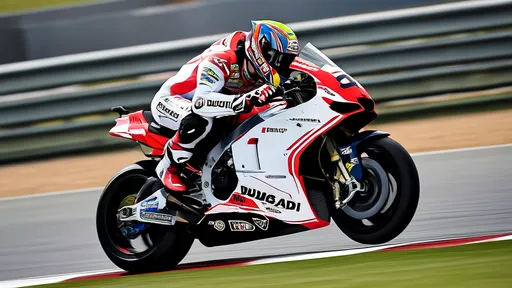
The 2024 MotoGP season has unfolded as a masterclass in precision engineering and rider supremacy, with Francesco Bagnaia’s relentless campaign to defend his crown taking center stage. At the heart of this dominance lies the Ducati Desmosedici GP24, a machine that has redefined the limits of cornering performance in modern Grand Prix racing. While raw straight-line speed has long been Ducati’s calling card, this year’s iteration has elevated their game to new heights, particularly in the twisty sections where races are often won or lost.
Bagnaia’s symbiotic relationship with the GP24 has become the stuff of legend. The Italian’s smooth, calculated riding style meshes perfectly with the bike’s ability to maintain staggering corner speeds without sacrificing stability. Unlike previous generations that required aggressive rider input to compensate for mid-corner unpredictability, the GP24 offers something revolutionary: predictability at the limit. This translates to Bagnaia carrying 5-8 km/h more through most apexes compared to rival machines, a margin that proves decisive when overtaking or defending position.
The engineering breakthroughs behind this cornering supremacy are multifaceted. Ducati’s chassis engineers have achieved what many considered impossible—maintaining the Desmosedici’s traditional strength under braking while eliminating its historical weakness in long, flowing corners. The carbon fiber reinforced aluminum front frame, an evolution of last year’s design, provides just enough flex to absorb bumps yet remains torsionally rigid to give Bagnaia telepathic front-end feel. Meanwhile, the rear suspension linkage geometry has been subtly reworked to keep the tire contact patch more consistently loaded during extreme lean angles.
Perhaps the most significant advancement comes from Ducati’s proprietary aerodynamics package. The GP24’s downwash ducts and revised wing profiles generate vortices that actually stabilize the bike as it leans over, counterintuitively increasing aerodynamic grip the further the bike tips into a corner. This phenomenon allows Bagnaia to begin accelerating earlier than his rivals, often getting the bike upright and driving forward while others are still wrestling with corner exit traction. The effect is most pronounced in medium-speed corners like those at the Red Bull Ring’s stadium section or Mugello’s Arrabbiata complex.
Electronics play an equally crucial role in the GP24’s cornering dominance. Ducati’s latest iteration of their engine braking control system has given Bagnaia unprecedented ability to modulate rear tire slide on corner entry. The seamless downshift algorithm works in harmony with the ride-height device to keep the chassis balanced during aggressive braking into turns. What appears as effortless cornering to spectators is actually a symphony of micro-adjustments happening between rider inputs and machine responses, all occurring within milliseconds.
The Desmosedici’s cornering prowess has forced rival manufacturers into reactive development cycles. Aprilia’s RS-GP has shown flashes of comparable performance in certain circuits, while KTM’s RC16 has made strides in maintaining corner speed through linked turns. Yet none have matched the Ducati’s ability to excel across all track configurations. This versatility has been key to Bagnaia’s title defense, allowing him to accumulate points consistently rather than relying on dominant performances at Ducati-friendly circuits.
Bagnaia’s mastery of the GP24’s capabilities was never more evident than at the recent German Grand Prix. The Sachsenring, with its relentless left-hand corners that traditionally favor agile, lightweight machines, became a showcase for Ducati’s engineering triumph. While rivals struggled with tire wear from constant cornering loads, Bagnaia maintained lap times within 0.3 seconds of his qualifying pace throughout the race. The data revealed his minimum corner speeds were consistently higher than any other rider’s by the halfway point, a testament to both machine superiority and his ability to preserve tires while riding at the limit.
The psychological impact of this cornering advantage cannot be overstated. When Bagnaia slots the GP24 into a corner with that characteristic planted feel, it sends a demoralizing message to competitors. They know that even if they match his braking markers and apex speeds, the Ducati will inevitably gain time in the transition from corner exit to full acceleration. This has led to several uncharacteristic mistakes from rival riders this season as they push beyond their machines’ limits to compensate.
Ducati’s relentless development culture ensures the GP24 continues evolving mid-season. Recent upgrades to the magnesium rear subframe have shaved precious grams while improving power transfer during corner exits. The team’s data engineers have also refined the traction control mappings to allow Bagnaia more progressive throttle application at maximum lean—a tweak that yielded immediate gains at circuits like Assen with its fast changes of direction.
As the championship enters its second half, the question isn’t whether Bagnaia can maintain this level of performance, but whether any rival can develop countermeasures before the season concludes. The GP24’s cornering supremacy has rewritten the rulebook on how modern MotoGP machines generate speed, proving that in an era of aerodynamics and electronics, the ability to carve perfect arcs through racing’s most demanding turns remains the ultimate weapon.
Bagnaia’s quiet confidence aboard the GP24 speaks volumes. Where previous Ducati champions like Stoner had to wrestle their machines into submission, the current combination represents harmony between Italian engineering and Italian riding finesse. Each corner becomes a statement, each apex a demonstration of why this partnership between man and machine stands atop the 2024 championship. The road to back-to-back titles may still have hurdles, but with the Desmosedici GP24 beneath him, Bagnaia’s path through every turn looks smoother than ever.
By /Jun 15, 2025
By /Jun 15, 2025
By /Jun 15, 2025
By /Jun 15, 2025
By /Jun 15, 2025
By /Jun 15, 2025
By /Jun 15, 2025
By /Jun 15, 2025
By /Jun 15, 2025
By /Jun 15, 2025
By /Jun 15, 2025
By /Jun 15, 2025

By /Jun 15, 2025

By /Jun 15, 2025
By /Jun 15, 2025
By /Jun 15, 2025
By /Jun 15, 2025
