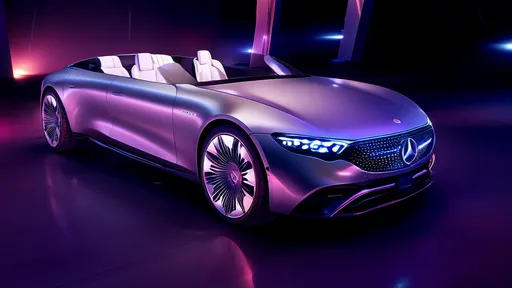
The automotive world has been buzzing with excitement since Mercedes-Benz unveiled its groundbreaking Vision EQXX concept car. This sleek, futuristic vehicle isn't just another pretty face in the crowded EV market - it represents a quantum leap in electric vehicle technology that could redefine our expectations for range, efficiency, and sustainable mobility.
Pushing the Boundaries of EV Range
What sets the EQXX apart from every other electric vehicle on the market today is its astonishing claimed range of over 1000 kilometers (621 miles) on a single charge. To put this into perspective, most current premium EVs struggle to achieve half that distance. The EQXX's range isn't just marginally better - it's in a completely different league, effectively eliminating range anxiety for all but the most extreme road trips.
Mercedes didn't achieve this breakthrough through brute force battery size either. While many automakers chase longer ranges by simply adding more battery cells (and weight), the EQXX takes a more sophisticated approach. Its relatively compact 100 kWh battery pack achieves nearly double the efficiency of Mercedes' current production EVs through an obsessive focus on reducing energy consumption at every level of the vehicle's design.
A Masterclass in Efficiency
The EQXX's secret lies in its holistic approach to efficiency. Mercedes engineers left no stone unturned in their quest to minimize energy waste. The car's drag coefficient of just 0.17 makes it the most aerodynamic production-ready vehicle ever created, slicing through the air with barely any resistance. Compare this to the already-slippery Tesla Model S (0.208) or Porsche Taycan (0.22), and you begin to understand how revolutionary this figure is.
But aerodynamics is just part of the story. The EQXX features numerous other efficiency-enhancing technologies. Its ultra-lightweight construction uses sustainable materials like mushroom-based leather alternatives and recycled plastic bottles. Even the tires were specially developed with Bridgestone to minimize rolling resistance without compromising safety or performance.
The Power of Software
Perhaps most impressively, Mercedes has leveraged cutting-edge software to maximize the EQXX's efficiency. The vehicle features a sophisticated energy management system that continuously optimizes power distribution based on driving conditions, route topography, and even weather forecasts. This digital brain can make thousands of calculations per second to ensure not a single watt of energy is wasted.
The cabin design also contributes to the efficiency gains. A minimalist interior reduces weight while maintaining Mercedes' legendary luxury standards. The innovative thermal management system uses phase-change materials to regulate temperature with minimal energy input. Even the sound system was re-engineered to deliver premium audio while consuming 30% less power than conventional systems.
Performance That Doesn't Compromise
Remarkably, all this efficiency doesn't come at the expense of performance. The EQXX's electric motor delivers 201 horsepower - not earth-shattering by EV standards, but more than adequate given the car's lightweight construction. More importantly, the focus on efficiency means the EQXX can maintain highway speeds for incredibly long distances without dramatic range loss.
During real-world testing, Mercedes demonstrated the EQXX's capabilities with a 1002 km journey from Stuttgart to Silverstone in the UK on a single charge. This wasn't a hypermiling stunt either - the car maintained normal traffic speeds with the air conditioning running, proving the technology works under realistic conditions.
Solar Power Assist
Adding to its efficiency credentials, the EQXX features an innovative solar roof that can add up to 25 km of range per day under ideal conditions. While not enough to power the vehicle independently, this supplemental energy source demonstrates Mercedes' commitment to exploring every possible avenue for extending range. In sunny climates, this could effectively eliminate the need for charging during daily commutes.
The solar cells themselves represent another technological breakthrough. Developed in partnership with Fraunhofer Institute, they're significantly more efficient than conventional automotive solar panels while being thin and flexible enough to conform to the EQXX's curved roof.
Production Prospects
While the EQXX remains a concept car for now, Mercedes has been clear that much of its technology will filter down to production models within the next few years. The company plans to use the EQXX as a testbed for next-generation EV technologies, with elements likely appearing in upcoming models from the EQ lineup.
This trickle-down approach makes sense when you consider that many of the EQXX's innovations - like its advanced battery chemistry, ultra-efficient drivetrain, and software optimizations - don't require the concept car's specific form factor to be effective. We could see production Mercedes EVs offering 800+ km ranges much sooner than many industry observers predicted.
Changing the EV Landscape
The EQXX's implications extend far beyond Mercedes' product lineup. By proving that 1000 km ranges are achievable without resorting to enormous, heavy battery packs, Mercedes has effectively raised the bar for the entire industry. Competitors will now need to match this level of efficiency or risk being left behind in what's becoming an increasingly sophisticated EV market.
Perhaps more importantly, the EQXX demonstrates that the future of electric mobility isn't just about bigger batteries, but about smarter engineering. Its holistic approach - combining aerodynamics, lightweight materials, software optimization, and energy recovery systems - provides a blueprint for how EVs can continue improving without necessarily requiring revolutionary new battery chemistries.
Sustainable Innovation
Mercedes has emphasized that the EQXX isn't just about performance numbers - it represents a more sustainable approach to EV design. By maximizing efficiency, the car requires fewer raw materials than less efficient EVs with comparable range. Many of its interior components are made from recycled or plant-based materials, pointing toward a future where luxury and sustainability aren't mutually exclusive.
Even the battery reflects this philosophy. The EQXX uses a new type of silicon-based anode that offers higher energy density than conventional graphite anodes while being more environmentally friendly to produce. Combined with the car's overall efficiency gains, this allows for a smaller, lighter battery that still delivers exceptional range.
The Road Ahead
As impressive as the EQXX is, it's important to remember that it's still a concept car. Bringing these technologies to mass production will present significant challenges in terms of cost, manufacturability, and durability. However, Mercedes' track record suggests that much of what we see in the EQXX will indeed make it to showrooms in some form.
What's perhaps most exciting about the EQXX is that it proves the electric vehicle revolution still has plenty of room for innovation. As the industry moves beyond simply replacing internal combustion engines with electric motors, we're seeing a new wave of creativity in how EVs are designed and engineered. The EQXX stands at the forefront of this movement, offering a tantalizing glimpse of what electric mobility could look like in the near future.
For consumers, the implications are clear: the days of range anxiety and frequent charging stops may soon be behind us. As technologies pioneered in the EQXX trickle down to production models, electric vehicles will become viable for an even wider range of applications, from long-haul road trips to commercial use cases that currently favor fossil fuels.
Mercedes hasn't just created another concept car with the EQXX - they've provided a vision of the future that's both inspiring and achievable. In doing so, they've reminded the automotive world that when it comes to electric vehicles, we're still just scratching the surface of what's possible.
By /Jun 15, 2025
By /Jun 15, 2025
By /Jun 15, 2025
By /Jun 15, 2025

By /Jun 15, 2025
By /Jun 15, 2025

By /Jun 15, 2025
By /Jun 15, 2025
By /Jun 15, 2025
By /Jun 15, 2025
By /Jun 15, 2025
By /Jun 15, 2025
By /Jun 15, 2025
By /Jun 15, 2025
By /Jun 15, 2025
By /Jun 15, 2025
By /Jun 15, 2025
