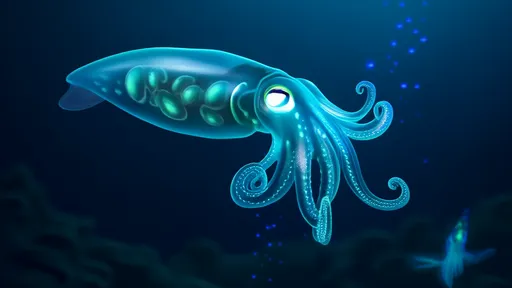
In the perpetual darkness of the deep ocean, where sunlight fades into oblivion, survival demands extraordinary adaptations. Among the most enigmatic inhabitants of this realm are deep-sea squid, masters of disguise that employ a combination of transparent tissues and bioluminescent organs to evade predators and ambush prey. Their camouflage strategies, refined over millions of years, offer a fascinating glimpse into the evolutionary arms race beneath the waves.
The deep sea is a world of shadows and silhouettes. Predators rely on detecting the faint outlines of their prey against the dim, downwelling light. To counter this, many deep-sea squid have evolved bodies that are almost entirely transparent. Their muscles, skin, and even internal organs allow light to pass through with minimal distortion, rendering them nearly invisible when viewed from below. This transparency is not merely a passive trait but a dynamic defense mechanism, honed by the relentless pressure of predation.
Transparency alone, however, is not always enough. At certain depths, where the faint glow of bioluminescent organisms creates a shifting mosaic of light and dark, squid face another challenge: their digestive glands and other opaque structures can cast telltale shadows. To compensate, some species have developed an ingenious solution—they use their own bioluminescence to mask these shadows. Specialized light-producing organs, called photophores, line their undersides, emitting a soft glow that matches the intensity and color of the ambient light from above. This counter-illumination effectively erases their silhouette, making them indistinguishable from the background.
The interplay between transparency and bioluminescence is a delicate balancing act. Researchers studying species like the glass squid (Teuthowenia pellucida) have found that their photophores are precisely tuned to the light conditions of their habitat. The squid can adjust the brightness of their glow in real time, responding to changes in the surrounding illumination. This ability suggests a level of control that borders on the miraculous, as if the squid possess an innate understanding of optics honed by evolution.
But the story doesn’t end there. Some deep-sea squid take their camouflage a step further by incorporating additional deceptive tactics. The Octopoteuthis deletron, for instance, can detach bioluminescent arm tips when threatened, leaving behind glowing decoys to distract predators while it escapes into the darkness. Others, like the Chiroteuthis, elongate their bodies with gelatinous tissue, further enhancing their transparency and reducing their detectability.
What makes these adaptations even more remarkable is the sheer diversity of strategies among different species. While some squid rely primarily on transparency, others combine it with counter-illumination, dynamic color changes, or even the ability to mimic other marine creatures. The firefly squid (Watasenia scintillans), for example, not only countershades its underside but also produces dazzling light displays to communicate with potential mates or confuse attackers.
The study of deep-sea squid camouflage is not just a scientific curiosity—it has practical implications as well. Engineers and material scientists are increasingly looking to these creatures for inspiration in developing new stealth technologies. From adaptive camouflage materials to energy-efficient lighting systems, the principles behind squid invisibility could revolutionize fields ranging from military defense to underwater exploration.
Yet, despite the advances in our understanding, much about these elusive creatures remains shrouded in mystery. The deep ocean is a challenging environment to study, and many squid species are known only from fragmentary specimens or fleeting encounters with remotely operated vehicles. Each new discovery peels back another layer of their secrets, revealing ever more sophisticated adaptations.
One thing is certain: the deep-sea squid’s mastery of light and transparency represents one of the most sophisticated survival strategies in the animal kingdom. In a world where being seen often means being eaten, their ability to vanish in plain sight is nothing short of evolutionary brilliance. As scientists continue to unravel the complexities of their camouflage, we are reminded of the boundless ingenuity of life in Earth’s most inaccessible realms.
By /Jun 9, 2025
By /Jun 9, 2025
By /Jun 9, 2025
By /Jun 9, 2025
By /Jun 9, 2025
By /Jun 9, 2025
By /Jun 9, 2025

By /Jun 9, 2025
By /Jun 9, 2025
By /Jun 9, 2025

By /Jun 9, 2025
By /Jun 9, 2025
By /Jun 9, 2025
By /Jun 9, 2025

By /Jun 9, 2025
By /Jun 9, 2025
By /Jun 9, 2025
