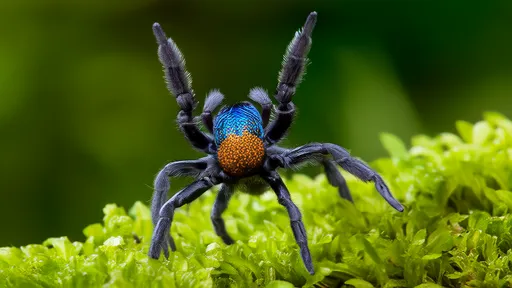
In the sun-dappled undergrowth of Australia's eastern coast, a dazzling spectacle unfolds each spring that would put most Broadway productions to shame. Male peacock spiders (Maratus genus) measuring barely 4-5 millimeters perform intricate courtship dances, combining rapid-fire leg taps, abdomen vibrations, and most remarkably, iridescent abdominal flaps that flash like microscopic stained-glass windows. These chromatic performances represent one of nature's most extraordinary examples of evolutionary theater – where survival hinges on perfecting a milliseconds-long light show.
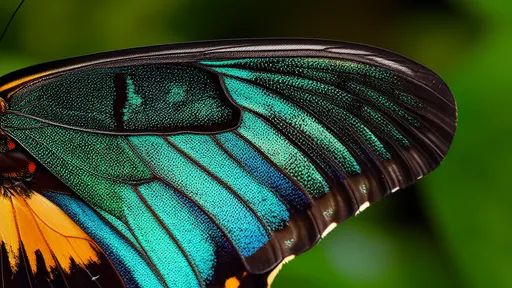
The biomechanics behind these color vibrations challenge conventional understanding of arthropod displays. Unlike butterflies that rely on static wing patterns, peacock spiders actively manipulate their opisthosomal (abdominal) flaps at speeds reaching 60 Hz – faster than the human eye can fully process. High-speed microscopy reveals that males don't merely extend these flaps, but dynamically adjust their angle relative to sunlight during each vibration. This creates a flickering effect where structural colors (produced by nanoscopic cuticular ridges) alternate between maximum brilliance and near-invisibility, generating what researchers call "chromatic pulsation."
What makes these displays even more remarkable is their precision in targeting the female's visual system. Female peacock spiders possess uniquely tiered retinas with UV, green, and deep-red receptors – an exceptionally broad spectrum for such small creatures. Males exploit this by incorporating multiple color bands in their flaps. The central patch often reflects intense violet (380-400nm), precisely matching the peak sensitivity of female UV photoreceptors, while outer bands stimulate their longer-wavelength receptors. This multichannel signaling ensures visibility across varying light conditions in their forest floor habitat.
The dance itself follows a rigid choreography that blends movement and color in specific sequences. It begins with the male positioning himself precisely 45-60mm from the female – the optimal distance for her to resolve both his movements and color details. Phase one involves lateral leg waves (called "semaphore") with duller frontal leg tufts, allowing the female to locate him without triggering her predatory instincts. Only after this non-threatening introduction does he suddenly rotate to present the iridescent flaps, commencing vibrations at frequencies between 30-80Hz depending on species.
Researchers using laser Doppler vibrometry discovered that the spiders' third pair of legs play a crucial role beyond visual signaling. By drumming specialized bristles against leaves at 128Hz, males create substrate-borne vibrations that precisely synchronize with their visual displays. This bimodal signaling appears critical – when scientists experimentally muted the vibrations, female receptivity dropped by 73%, suggesting the need for multisensory validation of male quality. The vibrations may convey information about the male's physical condition impossible to fake through visual signals alone.
Evolution has shaped these displays through intense sexual selection pressures. Females frequently cannibalize unsuccessful suitors, making each courtship a high-stakes performance. Detailed frame-by-frame analysis reveals that males scoring successful matings share three traits: their color vibrations maintain consistent frequency (±2Hz variation), their abdominal extensions reach full 90-degree angles within 5 milliseconds, and their vibration sequences contain precisely timed "pauses" every 1.8 seconds that may allow females to process the intense sensory input.
The structural colors themselves are marvels of natural nano-engineering. Unlike pigment-based colors, the spiders' iridescence comes from microscopic ridges on their abdominal flaps – some species have over 2000 parallel ridges per millimeter. Each ridge functions as a diffraction grating, splitting light into specific wavelengths. The spacing between ridges (ranging from 350-600nm across species) determines which colors are amplified. This explains why different Maratus species display distinct hues despite similar anatomy – ridge spacing has evolved to create species-specific color "signatures" that prevent crossbreeding.
Recent studies employing hyperspectral imaging uncovered an even more sophisticated layer: some species incorporate polarized reflections into their displays. When males of Maratus robinsoni perform their final approach, they rotate their flaps to create flashes of circularly polarized light – a visual effect invisible to humans but highly conspicuous to spider eyes. This may serve as a private communication channel, allowing males to signal without alerting predators or rival males. The discovery suggests these tiny arachnids manipulate light properties far beyond what our unaided eyes can perceive.
Conservation biologists are now investigating how environmental changes might disrupt these delicate visual communications. Preliminary data indicates that increased ambient noise (from human activities) interferes with the vibrational component of courtship, while habitat fragmentation may isolate populations until their color signals and female preferences drift out of sync. Some researchers propose that peacock spiders could serve as bioindicators – their extreme specialization making them sensitive markers of ecosystem health.
Beyond biological fascination, these miniature performers inspire technological innovation. Materials scientists are studying the spiders' color-producing nanostructures to develop ultra-thin, energy-free display technologies. Meanwhile, robotics engineers have created legged robots mimicking the spiders' vibration patterns to develop new communication protocols for swarm robotics. The spiders' efficient integration of visual, vibrational, and timing cues offers a masterclass in compact, multi-modal signaling systems.
As research continues, each discovery about peacock spiders reveals deeper layers of complexity in their thumbnail-sized world. Their existence reminds us that evolution's most dazzling creativity often unfolds not in the obvious splendor of large creatures, but in the microscopic dramas playing out beneath our feet – where survival depends on perfecting a split-second flash of color in the right place, at the right time, with precisely the right vibration.
By /Jun 9, 2025

By /Jun 9, 2025
By /Jun 9, 2025
By /Jun 9, 2025

By /Jun 9, 2025
By /Jun 9, 2025
By /Jun 9, 2025

By /Jun 9, 2025
By /Jun 9, 2025
By /Jun 9, 2025

By /Jun 9, 2025
By /Jun 9, 2025
By /Jun 9, 2025

By /Jun 9, 2025

By /Jun 9, 2025
By /Jun 9, 2025
By /Jun 9, 2025
