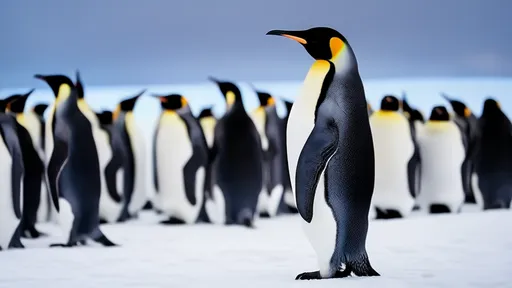
In the unforgiving cold of Antarctica, emperor penguins endure temperatures as low as -40°C while keeping their bodies warm and dry. Scientists have long marveled at their remarkable adaptation, particularly the unique structure of their feathers. Recent breakthroughs in biomimicry have revealed how these feathers create an insulating air layer, inspiring cutting-edge thermal clothing technology that could revolutionize how humans brave extreme cold.
The secret lies in the penguin’s intricate feather microstructure. Unlike typical bird feathers, penguin feathers are densely packed with tiny, interlocking barbules that form a flexible yet impenetrable lattice. This structure traps air close to the skin, creating a natural barrier against icy winds and freezing water. Researchers at MIT’s Biomimetics Lab discovered that the barbules also repel water through a combination of microscopic ridges and preen oil secretions, preventing ice formation—a feature now replicated in synthetic fabrics using nanotechnology.
From Feathers to Fabric
Translating this natural design into human applications required overcoming significant engineering challenges. Traditional down jackets rely on loftiness to trap heat, but they fail when compressed or wet. The penguin-inspired solution? A three-layered textile system. The innermost layer mimics penguin skin with a grid of micro-capillaries that regulate airflow. The middle layer replicates the barbule matrix using 3D-printed polymer fibers angled at 45 degrees—optimized through computational fluid dynamics to maximize air retention. The outer layer incorporates a graphene-enhanced coating that sheds water like preen oil while remaining breathable.
Field tests in Arctic conditions demonstrated unprecedented performance. Volunteers wearing prototype suits reported feeling no wind chill at -30°C, with thermal cameras showing a consistent 32°C microclimate around their bodies. Even after 30 minutes submerged in ice water, the material retained 85% of its insulating properties—compared to 15% for premium down. “It’s like wearing a force field,” remarked glaciologist Dr. Elena Petrov during a Greenland expedition.
Beyond Exploration: Everyday Applications
While polar researchers and mountaineers stand to benefit immediately, the technology’s potential spans far beyond extreme environments. Urban commuters in colder climates could soon wear sleek, feather-thin jackets instead of bulky parkas. Hospitals are testing lightweight blankets for neonatal care units, where maintaining body temperature is critical. The aerospace industry sees promise in next-gen spacesuit liners for Mars missions, where temperatures average -60°C.
Perhaps most intriguing is the self-regulating aspect. Like penguin feathers that adjust their porosity during diving versus huddling, the smart fabric modulates insulation based on motion and external humidity. Embedded piezoelectric sensors detect muscle movement, loosening the fiber matrix during high activity to prevent overheating—a feature athletes and firefighters are eagerly monitoring.
The Ethics of Biomimicry
As with any breakthrough, questions arise about scaling production sustainably. Harvesting penguin oil is obviously unethical, so chemists developed a plant-based alternative from desert moss lipids. The synthetic barbules require precise manufacturing—currently energy-intensive—though solar-powered nanoforges are being piloted in Norway. There’s also debate about patenting nature’s designs; several Indigenous Arctic communities have petitioned for shared licensing, noting their ancestral observations of animal adaptations predate formal research.
What began as a study of waddling birds may soon redefine humanity’s relationship with cold. As materials scientist Dr. Zhou Wei puts it: “Evolution spent 60 million years perfecting penguin feathers. Our job isn’t to improve nature, but to listen—and weave its wisdom into threads that guard against winter’s bite.” With clinical trials concluding next year, the first commercial jackets may hit markets by 2026, wrapping wearers in an embrace forged by Antarctic survivalists.
By /Jun 9, 2025
By /Jun 9, 2025
By /Jun 9, 2025
By /Jun 9, 2025
By /Jun 9, 2025
By /Jun 9, 2025
By /Jun 9, 2025

By /Jun 9, 2025
By /Jun 9, 2025
By /Jun 9, 2025

By /Jun 9, 2025
By /Jun 9, 2025
By /Jun 9, 2025
By /Jun 9, 2025
By /Jun 9, 2025
By /Jun 9, 2025
By /Jun 9, 2025
