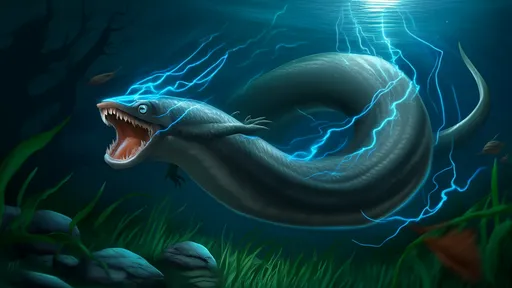
The electric eel, a creature that has fascinated scientists and laymen alike for centuries, possesses one of nature's most extraordinary abilities: the power to generate electric shocks of up to 600 volts. This remarkable capability, which serves both as a weapon and a sensory tool, is the result of millions of years of evolutionary refinement. The biological mechanisms behind this high-voltage discharge are a testament to the ingenuity of natural selection, offering insights that could inspire advancements in bioengineering and medical technology.
At the heart of the electric eel's shocking ability are specialized cells known as electrocytes. These cells, which make up about 80% of the eel's body, function like tiny biological batteries. Each electrocyte generates a small voltage, but when thousands of these cells discharge simultaneously, the cumulative effect is a powerful electric shock capable of stunning prey or deterring predators. The synchronization of these cells is a marvel of biological precision, orchestrated by the eel's nervous system with near-perfect timing.
The anatomy of the electric eel is uniquely adapted to support its electogenic lifestyle. Unlike most fish, the electric eel has a elongated body with a significant portion dedicated to its electric organs. These organs, which run along the length of its body, are divided into three distinct sections: the main organ, the Hunter's organ, and the Sachs' organ. Each of these organs serves a slightly different function, with the main organ responsible for the high-voltage discharges used in hunting and defense, while the other two organs produce lower-voltage pulses for navigation and communication.
What makes the electric eel's discharge particularly effective is not just the voltage, but the precise control it has over the timing and intensity of its shocks. The eel can modulate the strength of its discharge depending on the situation, delivering anything from a mild tingle to a full-force attack. This control is mediated by sophisticated neural circuits that can activate different numbers of electrocytes as needed. The speed at which these signals propagate through the eel's body ensures that the discharge is both instantaneous and coordinated.
The biochemical processes that power the electric eel's shocks are equally fascinating. Each electrocyte maintains an imbalance of sodium and potassium ions across its membrane, creating a potential difference similar to that found in human nerve cells. However, in the electric eel, these cells are stacked in series, much like batteries in a flashlight, allowing the voltages to add up. When the eel decides to discharge, acetylcholine neurotransmitters trigger the simultaneous opening of ion channels in all electrocytes, resulting in a sudden and massive flow of current.
Recent research has revealed that the electric eel's shocking ability may be even more sophisticated than previously thought. Studies have shown that the eel can use its electric field to remotely control the muscles of its prey, causing involuntary contractions that make the prey easier to capture. This phenomenon, known as "remote control," demonstrates how the eel's electric organ has evolved not just as a weapon, but as a precise tool for manipulating its environment. The implications of this discovery extend beyond biology, potentially informing the development of new technologies in fields ranging from robotics to neuromuscular medicine.
The electric eel's high-voltage system also raises intriguing questions about how the animal protects itself from its own shocks. Unlike the prey it stuns, the eel is remarkably resistant to the effects of its own electricity. This immunity is partly due to the arrangement of its vital organs, which are concentrated in a small area near the head and shielded by insulating tissue. Additionally, the eel's nervous system appears to have adaptations that prevent overstimulation during its own discharges. Understanding these protective mechanisms could lead to new approaches for safeguarding sensitive electronic equipment from power surges or developing better insulation materials.
From an evolutionary perspective, the electric eel's shocking capability represents a dramatic example of how environmental pressures can drive the development of extraordinary traits. In the murky waters of the Amazon basin where visibility is limited, the ability to sense and manipulate the environment through electricity provided a significant advantage. Over time, this led to the refinement of increasingly powerful electric organs, culminating in the high-voltage system we see today. The electric eel's story is a powerful reminder of how evolution can produce solutions to survival challenges that seem almost unimaginable.
Scientists continue to study the electric eel not just for what it can teach us about biology, but for the potential applications of its unique abilities. Researchers are exploring how the principles behind the eel's electrocytes might be harnessed to create new types of batteries or power sources. Others are investigating whether similar systems could be developed for medical purposes, such as targeted electrical therapies for neurological conditions. The electric eel, once viewed primarily as a curiosity of nature, is now recognized as a source of inspiration for cutting-edge technological innovation.
The electric eel's 600-volt discharge stands as one of the most dramatic examples of bioelectrogenesis in the animal kingdom. Its sophisticated biological battery system, precise neural control mechanisms, and evolutionary adaptations offer a window into nature's capacity for engineering solutions. As we continue to unravel the mysteries of this remarkable creature, we may find that the electric eel's most shocking revelation is not the voltage it can produce, but the depth of knowledge we can gain by studying nature's most extraordinary adaptations.
By /Jun 9, 2025
By /Jun 9, 2025
By /Jun 9, 2025
By /Jun 9, 2025
By /Jun 9, 2025
By /Jun 9, 2025
By /Jun 9, 2025
By /Jun 9, 2025
By /Jun 9, 2025
By /Jun 9, 2025

By /Jun 9, 2025
By /Jun 9, 2025
By /Jun 9, 2025
By /Jun 9, 2025

By /Jun 9, 2025
By /Jun 9, 2025
By /Jun 9, 2025
