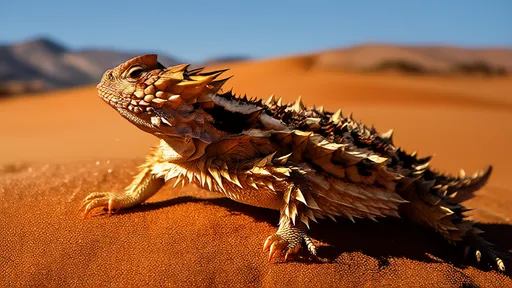
In the harsh, sun-scorched expanses of the Namib Desert, a small lizard has perfected the art of survival where few creatures can. The Namib Desert beetle may have stolen the spotlight with its fog-harvesting techniques, but the thorny devil lizard (Moloch horridus) has developed an equally ingenious method of extracting water from thin air—through its skin. Recent studies reveal that this reptile’s capillary-driven water collection system is a marvel of evolutionary engineering, offering potential breakthroughs for human applications in water-scarce regions.
The thorny devil’s survival hinges on its ability to condense and channel minuscule amounts of moisture from the air or damp sand. Unlike the beetle, which relies on surface chemistry to trap fog droplets, the lizard’s skin is a labyrinth of microscopic grooves and capillaries. These structures, invisible to the naked eye, function like a network of biological aqueducts. When the lizard presses its belly against cool morning sand or raises its body into fog-laden breezes, moisture condenses along these channels and is passively drawn toward its mouth through capillary action—no pumping or energy expenditure required.
What makes this system extraordinary is its dual adaptation to both condensation and transport. The grooves between the lizard’s scales are hierarchically structured: larger channels branch into progressively smaller ones, mimicking the fractal patterns of river deltas. This design maximizes surface area for condensation while minimizing resistance to water flow. Researchers at the University of Sydney used micro-CT scanning to map these pathways, revealing how droplets as small as a few micrometers coalesce into measurable volumes. "It’s a passive hydraulic system refined over millions of years," notes Dr. Philipp Comanns, a biologist who has studied the lizard’s skin for over a decade. "The geometry alone does the work."
The implications for biomimetic technology are profound. Engineers are now experimenting with synthetic surfaces that replicate the thorny devil’s capillary networks. One prototype, developed by a team at MIT, uses laser-etched polymers to create similar microgrooves. Early tests show a 300% increase in water collection efficiency compared to conventional fog nets. Unlike bulky desalination plants or energy-intensive condensers, these designs could lead to lightweight, scalable solutions for arid regions. "Nature has already solved the problem," says materials scientist Joanna Aizenberg. "We’re just learning to decode its blueprints."
Yet the lizard’s system isn’t foolproof. During prolonged droughts, even this adaptation reaches its limits. Field observations show that thorny devils become increasingly active at dawn—when humidity briefly spikes—to exploit fleeting moisture. Climate models predicting drier deserts raise concerns about the species’ long-term resilience. Conservationists argue that understanding these mechanisms isn’t just about human utility; it’s a race to document evolutionary ingenuity before it vanishes. As Australian ecologist Margaret Davies warns, "The same adaptations that let them survive extreme conditions also make them vulnerable to rapid change."
Beyond technology, the lizard’s skin offers a lesson in sustainability. Its water-harvesting operates entirely on physics—no external energy, no waste. In a world grappling with water scarcity and climate-driven droughts, such nature-inspired solutions could redefine how we think about resource extraction. From self-filling water bottles to drought-proof agricultural coatings, the thorny devil’s legacy might one day quench human thirst. For now, this unassuming reptile remains a masterclass in survival, its skin a living testament to the power of slow, precise evolution.
By /Jun 9, 2025

By /Jun 9, 2025
By /Jun 9, 2025

By /Jun 9, 2025

By /Jun 9, 2025

By /Jun 9, 2025
By /Jun 9, 2025

By /Jun 9, 2025

By /Jun 9, 2025

By /Jun 9, 2025

By /Jun 9, 2025

By /Jun 9, 2025

By /Jun 9, 2025
By /Jun 9, 2025

By /Jun 9, 2025

By /Jun 9, 2025

By /Jun 9, 2025
