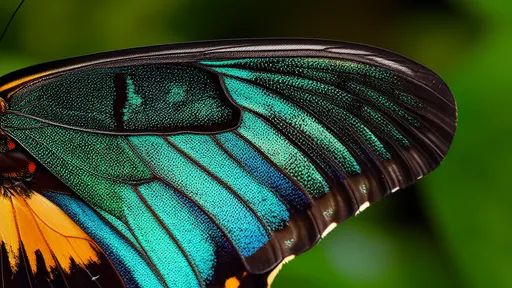
In the vibrant world of color production, nature has long been a master of innovation. While most living organisms rely on pigments to display hues, butterflies have evolved a far more sophisticated mechanism. Their wings shimmer with iridescent blues, radiant greens, and fiery oranges not through chemical pigments, but through an intricate play of light and nanostructures. This phenomenon, known as structural coloration, is rewriting the rules of how we perceive and produce color in materials science, fashion, and even anti-counterfeiting technology.
The secret lies in the microscopic architecture of butterfly wings. Unlike traditional pigments that absorb specific wavelengths of light and reflect others, these wings manipulate light through complex nanostructures. Tiny scales, often no thicker than a few hundred nanometers, are arranged in overlapping layers with precise spacing. When light hits these scales, it bends, diffracts, and interferes with itself, amplifying certain wavelengths while canceling others. The result is a dazzling display of color that shifts with the angle of view—a property impossible to achieve with conventional dyes.
Scientists have identified several structural designs in different butterfly species. The Morpho butterfly, famous for its brilliant blue wings, employs a "Christmas tree" structure of alternating cuticle and air layers that create constructive interference for blue light. Meanwhile, the Papilio blumei uses concave multilayers that produce both green and magenta from the same structure depending on viewing angle. These natural photonic crystals have inspired researchers to develop artificial counterparts that could revolutionize industries reliant on color production.
The implications extend far beyond aesthetic appeal. Traditional pigment manufacturing often involves toxic chemicals and complex synthesis processes. Structural color, being purely physical, offers an environmentally friendly alternative. Imagine paints that never fade because their color comes from geometry rather than chemistry, or fabrics that change hue without dyes. The military has taken note—research is underway to develop adaptive camouflage materials that can alter their appearance based on surroundings, much like how some butterflies can appear differently colored from various angles.
One particularly promising application is in display technology. Current screens rely on energy-intensive backlighting and color filters. Structural color could enable displays that are brighter, more energy-efficient, and visible even in direct sunlight. Researchers at Harvard have already created pixels using silicon nanostructures that reflect specific colors, paving the way for ultra-high-resolution screens. Another team at the University of Cambridge developed a flexible, structural color film that changes hue when stretched—potential for wearable sensors or interactive packaging.
The anti-counterfeiting industry stands to benefit tremendously. Banknotes, passports, and luxury goods currently use holograms and special inks that are expensive to produce. Structural color materials could offer more sophisticated, harder-to-replicate security features. The European Central Bank has reportedly investigated butterfly-inspired nanostructures for next-generation euro banknotes. Similarly, pharmaceutical companies are exploring ways to embed microscopic structural color patterns into drug packaging to combat counterfeit medicines.
Despite these exciting developments, challenges remain. Mass-producing materials with precise nanostructures at affordable costs is no small feat. Current fabrication techniques like electron-beam lithography are too slow and expensive for large-scale manufacturing. Researchers are exploring self-assembly methods inspired by how butterfly wings develop naturally during metamorphosis. Another hurdle is durability—while butterfly wings maintain their color for the insect's lifetime, artificial nanostructures often degrade with physical contact or environmental exposure.
Nature's blueprint offers solutions to these challenges too. Some butterflies have evolved protective coatings over their nanostructures that resist wear while maintaining optical properties. Materials scientists are now experimenting with similar transparent, hard coatings for artificial structural color materials. The field of biomimetics continues to uncover more secrets from these flying jewels, with each discovery bringing us closer to a future where color is engineered rather than dyed—a future painted not with brushes, but with nanostructures.
By /Jun 9, 2025
By /Jun 9, 2025
By /Jun 9, 2025
By /Jun 9, 2025
By /Jun 9, 2025
By /Jun 9, 2025
By /Jun 9, 2025
By /Jun 9, 2025
By /Jun 9, 2025
By /Jun 9, 2025

By /Jun 9, 2025
By /Jun 9, 2025
By /Jun 9, 2025
By /Jun 9, 2025

By /Jun 9, 2025
By /Jun 9, 2025
By /Jun 9, 2025
