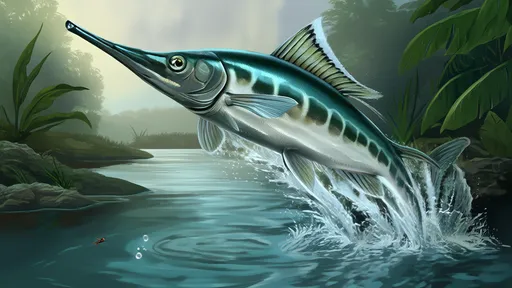
The natural world has always been a treasure trove of inspiration for scientists and engineers, offering elegant solutions to complex problems. Among its many marvels, the archerfish (commonly known as the shooting or spitfish) stands out for its remarkable ability to hunt prey above water while remaining submerged. This unique hunting technique requires precise vision across two vastly different optical environments—air and water—a challenge that would confound most creatures. Yet, the archerfish accomplishes this feat with astonishing accuracy, thanks to its specialized eye structure.
At the heart of this ability lies a biological innovation that could revolutionize underwater optics. Unlike humans, who struggle with blurred vision when opening their eyes underwater due to the refractive index mismatch between water and our cornea, the archerfish has evolved a sophisticated visual system that compensates for this distortion. Researchers studying this phenomenon have discovered that the fish's eyes contain a unique corneal shape and lens arrangement that effectively corrects for the visual parallax created at the water-air interface.
The implications of this discovery extend far beyond marine biology. This natural solution to underwater vision correction presents exciting possibilities for developing advanced diving equipment, underwater cameras, and even surgical instruments. Traditional diving masks create an air pocket in front of the eyes, which while effective, introduces distortion and limits peripheral vision. By mimicking the archerfish's ocular adaptations, engineers could create next-generation diving goggles that provide clearer, more natural vision without the need for an air space.
Detailed examination of the archerfish eye reveals several ingenious adaptations. The cornea is unusually flattened compared to terrestrial animals, reducing the refractive power that would otherwise cause severe focusing problems underwater. More remarkably, the lens exhibits a gradient refractive index, meaning its optical properties change gradually from center to edge. This sophisticated design allows the fish to maintain focus on objects both above and below the water's surface simultaneously—a capability that human-made optical systems struggle to replicate.
Perhaps most fascinating is how the archerfish's brain processes these visual signals. Neurobiological studies suggest that the fish's visual cortex has specialized neural pathways dedicated to interpreting the unique optical information provided by its eyes. This means the archerfish doesn't just see differently—it thinks about what it sees differently. The coordination between its physical optics and neural processing creates a seamless visual experience that transcends the water-air boundary.
The potential applications of this research are particularly relevant to underwater photography and videography. Current underwater camera housings suffer from many of the same optical limitations as human vision in water. By incorporating principles derived from archerfish eyes, camera designers could develop lenses that maintain clarity when transitioning between aquatic and aerial environments. This could revolutionize marine documentary filmmaking and scientific underwater observation, eliminating the need for complex corrective optics in camera systems.
Beyond recreational and scientific diving, medical science could benefit from these insights. Microsurgery, particularly procedures involving fluid-filled environments like the eye or abdominal cavity, often requires surgeons to work while viewing through distorted optical systems. Archerfish-inspired visualization tools could provide clearer, more accurate views during delicate procedures, potentially improving surgical outcomes. Some researchers are even exploring how these principles might enhance vision correction for people with certain types of visual impairments.
As biomimicry continues to gain traction in engineering circles, the archerfish stands as a prime example of nature's ingenuity. What began as curiosity about a small tropical fish's hunting behavior has blossomed into a multidisciplinary research effort spanning optics, neuroscience, and materials science. The journey from biological observation to technological application exemplifies how careful study of nature's solutions can lead to breakthroughs that benefit multiple fields.
The story of the archerfish's visual system also highlights an important truth about evolution's problem-solving prowess. Over millions of years, this species has refined its vision to perfection within its ecological niche. In our rush to develop new technologies, we often overlook the fact that nature has already solved many of the challenges we face—we just need to know where to look. As research into bio-inspired optics continues, the humble archerfish may well become the unlikely muse for a new generation of optical technologies that blur the boundary between water and air.
By /Jun 9, 2025
By /Jun 9, 2025

By /Jun 9, 2025
By /Jun 9, 2025

By /Jun 9, 2025
By /Jun 9, 2025
By /Jun 9, 2025

By /Jun 9, 2025
By /Jun 9, 2025
By /Jun 9, 2025

By /Jun 9, 2025

By /Jun 9, 2025
By /Jun 9, 2025

By /Jun 9, 2025

By /Jun 9, 2025
By /Jun 9, 2025
By /Jun 9, 2025
