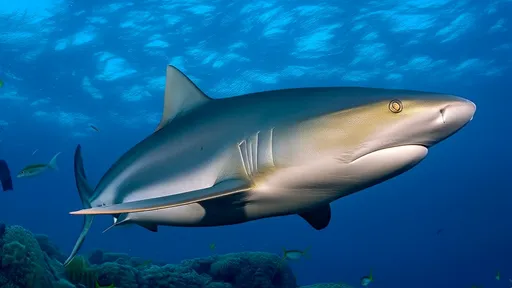
The ocean is home to some of nature's most ingenious hitchhikers, and few are as fascinating as the remora, also known as the suckerfish. This remarkable creature has evolved a suction disc on its head that allows it to latch onto larger marine animals like sharks, rays, and even boats. Unlike man-made suction devices, the remora's adhesive mechanism operates flawlessly in turbulent water, resists bacterial growth, and leaves no trace when detached. Scientists and engineers are now looking to this natural design as inspiration for next-generation vacuum technologies with applications ranging from medical devices to underwater robotics.
What makes the remora's suction disc so extraordinary is its intricate structure. The disc consists of soft, fleshy tissue lined with rows of tooth-like structures called lamellae. When the remora presses its disc against a surface, these lamellae create hundreds of tiny chambers. By retracting the disc slightly, the fish generates negative pressure within these chambers, forming a powerful vacuum seal. This biological design achieves what human engineering struggles with—maintaining adhesion on rough, uneven, or fouled surfaces while requiring minimal energy to attach and release.
The potential applications of remora-inspired vacuum technology are vast. In marine robotics, researchers are developing soft robotic grippers that can attach to irregular surfaces underwater without damaging them. These could be used for underwater infrastructure inspection or delicate coral reef studies. Medical device companies are exploring how similar principles could create gentler wound closure systems or non-invasive surgical tools. Even space agencies have taken notice, as this technology might enable spacecraft to dock with asteroids or space debris more securely.
One of the most promising aspects of this biomimetic approach is its energy efficiency. Traditional vacuum systems require continuous power to maintain suction, but the remora's disc maintains its grip passively once engaged. Engineers are now working to replicate this feature in artificial systems. Early prototypes use shape-memory materials that mimic the remora's ability to create and release suction through subtle structural changes rather than mechanical pumps. This could lead to vacuum technologies that work in power-limited environments or during equipment failures.
The remora's adhesion system also solves problems that plague conventional suction devices. Unlike rubber suction cups that fail when dirt gets between the cup and surface, the remora's lamellae can conform around small particles. The disc's surface naturally resists marine biofouling—a property that could revolutionize underwater equipment design. Perhaps most impressively, the remora can maintain its grip while its host animal accelerates rapidly through water, suggesting applications for high-speed transportation or industrial handling systems.
As research progresses, scientists are discovering even more sophisticated aspects of the remora's design. Recent studies show that the spacing and flexibility of the lamellae create optimal fluid dynamics when attached to moving surfaces. The disc's collagen fibers are arranged in specific orientations to handle different directional forces. These findings are informing new composite materials that could lead to vacuum pads capable of adhering to surfaces moving at high velocities or under extreme conditions.
Commercial applications are already emerging. Several startups have developed remora-inspired temporary mounting systems for marine equipment that outperform traditional methods. One company has created a surgical retractor that gently holds tissue without causing damage, while another is testing underwater cleaning robots that can attach to ship hulls without scraping off protective coatings. The U.S. Navy has funded research into remora-like attachments for underwater drones that could recharge by hitching rides on submarines or other vessels.
Beyond practical applications, the study of remora adhesion is changing how scientists think about bio-inspired design. Unlike many biological models that have been simplified for engineering purposes, researchers are finding that the complexity of the remora's disc is essential to its function. This realization is leading to new approaches in biomimetics that embrace rather than reduce nature's intricate solutions. As one researcher noted, "The remora teaches us that sometimes evolution's most elegant solutions appear messy at first glance—until you understand how all the pieces work together."
Looking ahead, the full potential of remora-inspired vacuum technology may take years to realize. Current prototypes still can't match the fish's ability to attach to rapidly moving, rough surfaces in turbulent water. However, with advances in materials science and 3D printing, engineers are getting closer. Some predict that within a decade, we may see everything from new industrial handling systems to revolutionary medical devices based on this ancient marine hitchhiker's design. As often happens, nature proves to be the most brilliant engineer—we just need to learn how to copy its homework properly.
The story of the remora's suction disc reminds us that some of the most advanced technologies don't come from laboratories, but from millions of years of evolutionary refinement. As we face growing challenges in medicine, robotics, and sustainable technology, looking to nature's solutions may provide answers we couldn't imagine on our own. The humble remora, long considered just a curious passenger of the seas, may ultimately help us develop technologies that transform multiple industries while working in harmony with natural principles.
By /Jun 9, 2025
By /Jun 9, 2025
By /Jun 9, 2025

By /Jun 9, 2025

By /Jun 9, 2025
By /Jun 9, 2025
By /Jun 9, 2025
By /Jun 9, 2025
By /Jun 9, 2025
By /Jun 9, 2025

By /Jun 9, 2025

By /Jun 9, 2025
By /Jun 9, 2025

By /Jun 9, 2025

By /Jun 9, 2025
By /Jun 9, 2025
By /Jun 9, 2025
